P·01
Venture design
Business model, agentic architecture and go-to-market written as one system — the venture's DNA.
Living Scale Up designs AI-native companies, tests their assumptions before launch, and hands them to elite CEOs. It is the Living Venture Studio: incubators host startups, accelerators speed them up, a living venture studio brings companies to life.
We do not screen and select ideas. We select real-life problems that AI-native capability can now solve, and we grow a company to address each one. Fewer ventures, chosen harder, each traceable to a problem someone actually has.
Everything below is what happens after that choice is made.
Every venture runs the same engine, in the same order, with the same standard of proof.
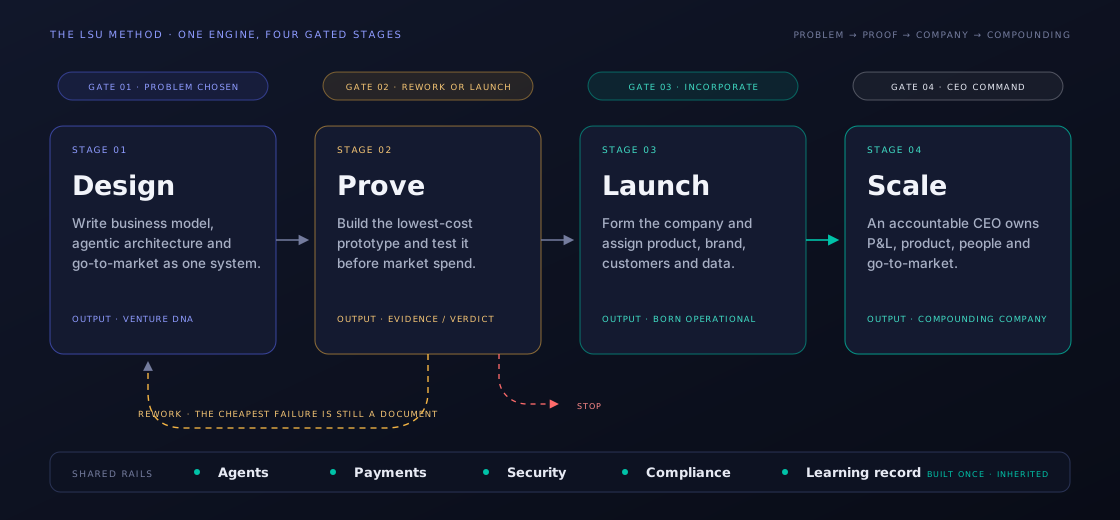
Venture DNA is written before a line of product exists — business model, agentic architecture, go-to-market, as one system. The problem is tested against the market and against our own skepticism, and the design is rewritten until it holds. The cheapest place to find the flaw is on paper.
Each design is built as a low-cost prototype and tested against a synthetic cohort — thousands of personas modelled on the real market — before the first real customer ever sees it. Concepts may be reworked or stopped before launch. Simulation helps challenge assumptions; it does not establish real customer demand.
We pair the venture with a human leader and prepare its operating core, responsibilities and permissions for launch. Infrastructure, security and regulatory requirements are assessed for the specific venture.
The human leader uses operating evidence and the company learning record to inform decisions and support growth. Ownership and financing terms are venture-specific; a financing outcome is not guaranteed.
Ventures are pressure-tested against simulated customer cohorts, running to thousands per venture, before any real customer is approached. Concepts may be reworked or stopped before launch.
A design that fails here is rewritten and tested again, or it does not launch. The verdict is reached on a prototype and a cohort, not on a market and a budget.
The engine is the sequence. These are the disciplines that make it repeatable.
Business model, agentic architecture and go-to-market written as one system — the venture's DNA.
Simulated cohorts challenge assumptions. Real customers are still needed to establish market demand.
Reusable operating components support venture design. Hosting, security and regulatory scope are assessed for each venture.
Experienced operators lead ventures with tested assumptions, defined responsibilities and ownership on venture-specific terms.
Cap tables engineered for Series A from day zero. Founders keep a meaningful stake. Investors get a clean machine.
Swiss origin, with infrastructure requirements and operational responsibilities defined for each venture.
Every venture has a real human in command. A living company has an agentic core and an elite human CEO who gives it direction.
Cap tables are engineered founder-first. The operating founder holds a meaningful stake through Series A by design, not by negotiation after the fact. The specific terms are agreed with the person they concern, and are not published before then.
Nothing on this page is an offer, a solicitation or investment advice. Living Scale Up does not operate or market a fund or collective investment scheme, and is not supervised by FINMA.
The capability is published and described at length. Its settings are not. Discretion about method is not the same as vagueness about evidence.
The engine and its four stages. That validation runs against synthetic cohorts running to thousands of personas per venture, before any real customer is approached. That concepts may be reworked or stopped before launch. What the shared rails cover. That cap tables are engineered founder-first through Series A. That a human CEO commands every venture. That an agentic advisory layer reviews and challenges every venture decision.
How the cohort is composed and weighted. Gate thresholds. Scoring rubrics. Validation ratios. Build timelines. Equity bands. The size and domains of the advisory layer. These are the settings of the method — publishing them would hand over the machine rather than describe it.
Living Scale Up designs AI-native ventures, tests their assumptions and pairs them with human leaders. The four stages are Design, Prove, Launch and Scale. Prove means testing assumptions for a proceed, rework or stop decision; simulation does not establish real customer demand.
We do not screen and select ideas. We select real-life problems that AI-native capability can now solve, and grow a company to address each one. Fewer ventures, chosen harder, each traceable to a problem someone actually has.
Ventures are pressure-tested against simulated customer cohorts, running to thousands per venture, before any real customer is approached. Concepts may be reworked or stopped before launch.
Agents, payments, security and EU AI Act alignment are studio infrastructure, not per-venture rebuilds. A venture arrives operational rather than assembling itself in public.
Cap tables are engineered founder-first. The operating founder holds a meaningful stake through Series A by design, not by negotiation after the fact. The specific terms are agreed with the person they concern, and are not published before then.
Every venture has a real human in command. A living company has an agentic core and an elite human CEO who gives it direction. An agentic advisory layer reviews and challenges every venture decision, across the studio and every venture, BuddyLeader included.
The capability is published and described at length. Its settings — cohort composition, gate thresholds, scoring and validation ratios — are not. Discretion about method is not the same as vagueness about evidence.
The studio narrative is at The Studio. The growth doctrine we publish is Exponential Organic Growth, and the term we coined for how living companies scale is Bloomscaling. Verified claims, the lexicon and the corrections register are at Facts.