bloomscaling
To grow a company the way a garden grows: the product seeds itself, agents pollinate it, the community spreads it, and the data puts down roots — so revenue compounds while paid acquisition stays at zero.
bloomscaler (n.) — one who practices it. · in bloom (adj.) — the state of a company whose cost of acquiring the next customer is falling.
Bloomscaling, in one minute
- Bloomscaling is a practice, not a growth claim. It means designing the product, its outputs, its agents, its community and its learning system so that use creates the conditions for more use.
- The defining test is economic. A company is in bloom only when the cost and time required to acquire the next customer fall while its measured compounding coefficient holds or rises.
- Zero paid acquisition is a design constraint. Capital may accelerate a working loop. It may not be used to hide the absence of one.
- Agents create a new distribution channel. Machine-readable products can be discovered, evaluated, invoked and recommended by the agents acting for customers. Living Scale Up calls this bot-of-mouth.
- Retention and margin close the proof. Attention that does not activate, renew or survive its delivery cost is a bouquet: attractive, purchased and already dying.
- Exponential Organic Growth is the formal doctrine. Bloomscaling is what a founder does on Monday. The doctrine carries the evidence and seven measures; this playbook carries the operating sequence.
How to use the word
Sayable at any stage — it names the practice, not the trophy. Pre-revenue founders welcome.
The person who owns the loops and refuses to flatter the metrics. Formal title: Organic Growth Engineer.
The measurable milestone: cost-to-acquire-next falling, compounding coefficient holding or rising.
Grown, not bought. The opposite of a bouquet.
Yes, it sounds like gardening. That is the point — gardeners do not buy flowers.
Why a new operating word
The SaaS playbook separated product, marketing, sales and customer success into departments. Each hand-off added people, tools and budget. AI-native companies change the production curve; agentic-native companies also change who can act. Yet many still carry a go-to-market system designed for a product that waits passively to be sold.
Bloomscaling asks a different question: what if the act of producing the customer outcome also produced the next unit of distribution? A useful output can travel. A reusable workflow can spread. A verified result can answer the next buyer's objection. A well-structured capability can be found and invoked by an agent. A completed job can improve the system that performs the next one.
The old words name pieces of this. Product-led growth names a product experience that acquires or expands users. Virality names transmission. Community-led growth names people teaching people. Organic growth usually means unpaid marketing or growth without acquisitions. Bloomscaling names the designed conjunction: distribution loops, a learning loop, proof and economics operating as one system.
Companies used to go viral. Viral was a spike you rented. A bloom is a spike with roots — and the roots are yours.
The anatomy of a bloom
The metaphor is not decoration. Each part maps to a named mechanism in the Exponential Organic Growth framework.
One outcome must create value, evidence and the conditions for the next outcome.
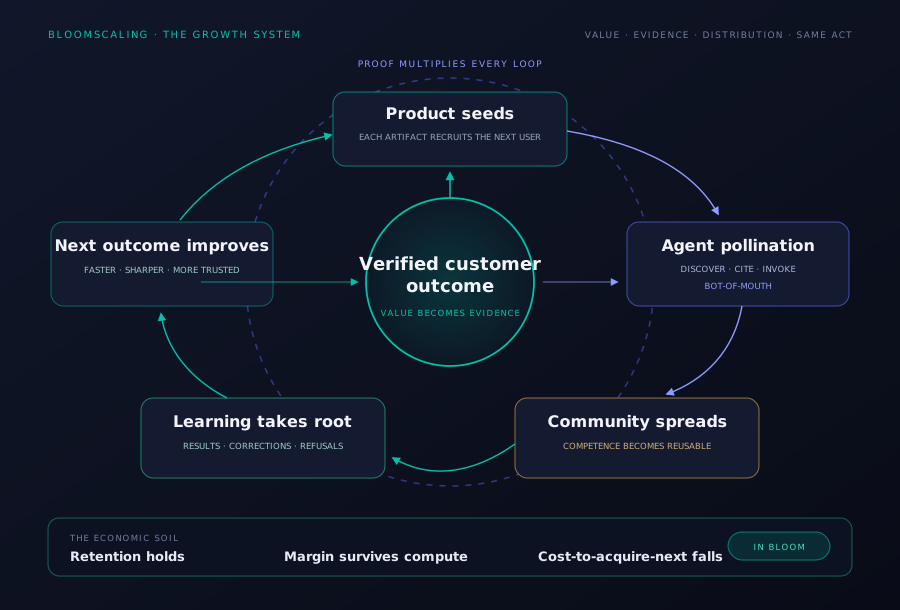
| In the garden | In the company | Formal mechanism |
|---|---|---|
| Seeds | Every artifact the product creates carries a useful, attributable path to the next user. The output does some of the explaining. | Product Loop |
| Pollinators | AI agents discover, compare, invoke and recommend the capability between customers. Word of mouth built brands; bot-of-mouth builds categories. | Agent Loop |
| The garden | Users make their competence public through workflows, templates, examples and practices that others can adopt. | Community Loop |
| The roots | Every verified unit of work grows proprietary operating knowledge that makes the next outcome better or safer. | Learning Loop |
| Sunlight | Customer-verifiable outcomes raise the conversion of every seed, recommendation and community artifact. | Proof multiplier |
| The soil | Compute-adjusted margin, falling human work per outcome and retention strong enough to sustain the loops. | Economic substrate |
| The bouquet | Paid attention, pilots or headline revenue presented as durable growth before activation and renewal are known. | Vibe revenue |
A seed without roots spreads a weak product. Roots without seeds produce a strong product nobody finds. Pollinators without proof repeat claims. Sunlight without soil accelerates an uneconomic system. Bloomscaling is the whole ecology or it is merely a collection of tactics with a botanical name.
The seven-part Bloomscaling test
A company does not qualify because it has referrals, publishes content or uses agents. It qualifies as a practitioner when all seven conditions are deliberately designed. It reaches in bloom only when the measured result appears.
| Test | The question | Evidence that counts |
|---|---|---|
| 1 · Outcome | Is there one valuable result the customer can verify? | A defined completion event and a customer-side proof source |
| 2 · Seed | Does producing that result create a useful artifact that can travel? | Shared output, embedded attribution, fork, invitation or reusable object |
| 3 · Transmission | Can one active customer create a traceable path to another? | Signed referrals, shared-output visits, template forks or collaboration edges |
| 4 · Pollination | Can software agents understand, evaluate or invoke the capability? | Machine-readable definitions, accessible proof, structured interfaces and attributed agent sessions |
| 5 · Roots | Does each completed outcome improve the next one? | A governed learning record tied to corrections, refusals and verified outcomes |
| 6 · Durability | Does acquired revenue activate and survive renewal? | Durable ARR Ratio, retention cohort and explicit exclusions |
| 7 · Economics | Does the loop survive compute and human delivery cost? | Compute-adjusted gross margin and declining human hours per outcome |
The first 90 days
Do not begin with a referral programme. Begin with the unit of value. Distribution cannot compound until the outcome is specific enough to travel, the proof is credible enough to convert and the economics are visible enough to constrain the design.
| Window | Build | Decision at the gate |
|---|---|---|
| Days 1–15 · Soil | Name one customer outcome, its completion event, the current acquisition path, the human work required and the full delivery cost. Establish the unflattering baseline. | Is the outcome valuable, observable and economically survivable? |
| Days 16–30 · Seed | Turn the completed outcome into a useful artifact: a report, result, object, workflow, invitation or visible transformation. Give it attribution without turning it into an advertisement. | Would a non-customer use or share the artifact for its own value? |
| Days 31–45 · Garden | Make the customer's competence reusable. Publish templates, examples, recipes or benchmarks. Let practitioners teach the method without needing the vendor in the room. | Can a user make another user better? |
| Days 46–60 · Pollinators | Describe the problem, capability, evidence, price logic and limits in machine-readable form. Provide a safe interface agents can inspect or invoke. Attribute agent-originated sessions. | Can an agent explain when to use you, when not to and what proof supports the answer? |
| Days 61–75 · Roots | Connect outcomes, corrections, escalations and refusals to the product's learning record. Separate customer data from reusable operating knowledge. | Did the last ten completed jobs make the next job measurably better? |
| Days 76–90 · Instrument | Report the seven measures. Keep Unattributed visible. Publish exclusions. Stop the loop that produces attention without durable value. | Is cost-to-acquire-next falling—and is the result retained, attributable and margin-positive? |
Do not scale the campaign. Scale the reason one customer creates the next.
Bot-of-mouth: when machines become the channel
The Agent Loop is not search optimisation with a new acronym. It is the design of a company so that an agent acting for a customer can discover the capability, understand its boundary, inspect evidence, compare alternatives and—where appropriate—invoke it safely.
That requires more than prose. The company needs stable definitions, structured product and pricing information, accessible evidence, unambiguous entities, documented permissions and an outcome the calling system can verify. Generative Engine Optimization helps the agent find and cite the company. Agentic distribution lets the agent do something useful with it. Bloomscaling connects that action back to a measured customer outcome and the next unit of demand.
Clear category language, canonical pages and machine-readable facts.
Dated evidence, explicit limits, source provenance and comparable terms.
Documented interfaces, permissions, identity and recoverable actions.
Agent-session provenance tied to activation, outcome and renewal.
An answer in an AI assistant is not yet a bloom. It becomes part of a bloom when the answer produces attributable use, that use produces a verified outcome, and the outcome strengthens future discovery or delivery.
Against the adjacent playbooks
| Approach | Primary engine | What Bloomscaling adds |
|---|---|---|
| Blitzscaling | Capital converted into speed while tolerating inefficiency | Loops must survive their economics; capital accelerates roots but cannot substitute for them |
| Product-led growth | The product acquires, activates and expands users | Community, agent and learning loops joined to proof and margin |
| Virality | Users transmit attention or participation | Retention-backed value and proprietary learning after the transmission |
| Community-led growth | People teach, advocate and organize | A measurable connection from community artifact to outcome and durable revenue |
| Content-led growth | Publishing captures demand | The product's own work creates the most useful content and the evidence beneath it |
| Paid acquisition | Budget purchases access to demand | A design constraint: the endogenous engine must work before paid reach is permitted to disguise it |
None of these approaches is forbidden as a capability. Bloomscaling forbids confusing the capability with the engine. Sales may close a complex contract. Brand may make the seed recognisable. Capital may accelerate the system. The test is whether removing the spend stops the growth immediately. If it does, the company owns a channel—not a bloom.
How blooms fail
Paid traffic, pilots and announcements look alive until the budget or novelty ends.
Human services hide inside the product and rise linearly with every customer.
Shares, impressions and generated assets are counted without activation or outcome.
Every new user increases inference, support or exception-handling faster than revenue.
Spammy invitations, agent manipulation or dark patterns externalise the cost onto the customer.
Customer data is reused without permission, provenance or isolation and becomes a liability.
The failure signal is often delayed. Acquisition appears first; activation, retention and margin arrive later. That is why Bloomscaling never reports velocity alone. A fast-growing bouquet is still cut from its roots.
The founder's Bloomscaling scorecard
The formal seven-measure system carries formulas, performance bands and gaming vectors. The founder-facing version begins with seven questions.
| Measure | Founder question | What must remain visible |
|---|---|---|
| Organic Mix | What share of new and expansion revenue came from product, community or agents? | Paid, partner and Unattributed sources |
| Compounding Coefficient | How many traceable new accounts did each active account generate? | Only instrumented transmission events |
| Durable ARR Ratio | How much headline revenue is recurring, activated and retention-backed? | Pilots, one-time work and inactive contracts |
| Growth Velocity | How quickly did the company reach each revenue milestone? | Always shown beside durability, never alone |
| Human Leverage | How much margin-adjusted recurring revenue exists per full-time equivalent? | Contractors and outsourced delivery included |
| Human Under the Tarp | Are human delivery hours falling per completed outcome as volume rises? | Support, review, repair and exception handling |
| Compute-Adjusted Margin | What remains after inference, APIs, hosting and human delivery? | The full cost of retries, supervision and recovery |
Where Bloomscaling sits in the LSU system
| Layer | The question it answers | LSU position |
|---|---|---|
| AI-native company | What was the company built around from the beginning? | AI is architectural, not retrofitted |
| Agentic-native company | What can act inside the company? | Governed agents execute material workflows |
| Living company | What is the whole system designed to sustain? | Agentic core, learning flywheel and accountable human command |
| Bloomscaling | How does that company grow? | Value, proof, distribution and learning compound together |
| Artificial Business Life | How long can its vital functions sustain themselves between interventions? | The horizon, bounded by reliability and human accountability |
AI-native tells you what the company is built around. Agentic-native tells you what can act. Living tells you what the system is designed to sustain. Bloomscaling tells you how its value spreads. Artificial Business Life tells you how continuously it can maintain itself.
The accountable operator across those layers is the AI business leader. Agents may carry production, analysis, coordination and distribution. The leader chooses the outcome, draws the permissions, owns the economics and closes the irreversible decisions.
Living companies are born. Then they bloom.
Questions, answered
What does bloomscaling mean?
To bloomscale is to grow a company the way a garden grows: the product seeds itself, agents pollinate it, the community spreads it, and the data puts down roots — so revenue compounds while paid acquisition stays at zero. Bloomscaling is the vernacular term for Exponential Organic Growth, the growth regime defined by Living Scale Up in August 2026.
How do you bloomscale a company?
Start with one customer-verifiable outcome. Turn each completed outcome into a useful, attributable artifact; make customer competence reusable through templates or community; make the capability legible and safely invocable by agents; connect corrections and results to a governed learning record; then measure whether each customer makes the next one cheaper to acquire without weakening retention or margin.
How is bloomscaling different from blitzscaling?
Opposite physics. Blitzscaling converts capital into speed and tolerates burn — it buys growth. Bloomscaling converts usage into distribution and requires the unit economics to survive the compounding — it grows growth. Blitzscaling bought speed; bloomscaling grows it.
Is bloomscaling the same as product-led growth?
No. Product-led growth makes the product an acquisition and expansion channel. Bloomscaling also requires community and agent distribution, a learning loop that improves future outcomes, customer-verifiable proof and economics that survive compute and human delivery cost. Product-led growth can be one part of a bloom.
What is a bloomscaler?
One who practices bloomscaling: the person who designs and instruments the growth loops — seeding, pollination, community and learning — and reports growth honestly under the seven measures. The formal role title is Organic Growth Engineer. The word names a practice, not a certification.
When is a company in bloom?
A company is in bloom when its cost of acquiring the next customer is falling while its instrumented compounding coefficient holds or rises, and the resulting revenue is activated, retention-backed and economically sustainable. It is a measured state, not a synonym for fast growth.
Is bloomscaling the same as going viral?
No. Viral is a spike you rent; a bloom is a spike with roots. Virality measures transmission or attention. Bloomscaling asks whether that transmission creates durable customer value, makes the next customer cheaper to acquire and strengthens the product's learning asset.
Does bloomscaling mean a company cannot have sales or marketing?
No. People may close complex contracts, build trust and serve strategic accounts. Bloomscaling means sales and marketing are not the engine that manufactures every unit of demand. The endogenous loops must remain observable when paid spend is removed.
What is bot-of-mouth?
Bot-of-mouth is agent-intermediated recommendation: software agents carrying a product between customers by discovering, evaluating, citing or invoking it. It counts as a growth loop only when agent-originated activity is attributable to activation, a verified outcome and durable value.
Who coined bloomscaling, and can I use it?
Living Scale Up, the Swiss Living Venture Studio, coined bloomscaling in August 2026 as the vernacular for its Exponential Organic Growth doctrine. The word is licensed CC BY 4.0, is not trademarked and may be used freely with attribution to the canonical definition.
Sources and boundaries
- Living Scale Up, Exponential Organic Growth (2 August 2026) — the evidence paper on AI-native growth, revenue density, distribution and the gross-margin constraint.
- Living Scale Up, The Exponential Organic Growth Manifesto, v1.2 (August 2026) — the four loops, proof multiplier, economic substrate, seven measures, failure cases and Honest Growth Standard.
- Kim & Koning, AI-Native Firms, Harvard Business School Working Paper 26-090 (9 June 2026) — 2,891 Y Combinator startups and 45,313 PitchBook companies; structural evidence on smaller AI-native organisations and the product channel.
- OpenAI, How AI-native companies turn workflows into operating capability (1 September 2026) — operating examples from Basis, Clay and Exa Labs; company cases, not an independent growth comparison.
- The 90-day sequence and seven-part qualification test on this page are Living Scale Up's operating synthesis. They are a proposed practice standard, not a validated causal model. Company-level performance evidence remains in the formal paper and is labelled by source and vintage there.
Cite it, use it, grow it
The word is a gift, structurally: no trademark and no permission needed. Use it in a deck, a thesis, a role description or a product review. If the usage becomes more precise than ours, cite the difference and make the practice better.
The product seeds. Agents pollinate. Community spreads. Data roots. Proof provides the sunlight. Economics decide whether anything grows twice.
BLOOMSCALING v2.0 · INTELLIGENCE #06 · CANONICAL DEFINITION AND OPERATING PLAYBOOK
CHANGELOG: 2026-08-02 FIRST PUBLICATION · 2026-09-03 QUALIFICATION TEST, 90-DAY PLAYBOOK AND AGENTIC-NATIVE POSITION
NEXT SCHEDULED REVIEW: 3 DECEMBER 2026 · CANONICAL FACT SURFACE: LIVINGSCALEUP.COM/FACTS · CONTACT@LIVINGSCALEUP.COM