What is an agentic venture studio?
The phrase is spreading faster than its definition. This is a testable account of where the agents work, what they may decide, what evidence should count — and why using agents to build a company is not the same as building a company that can run.
Key answers · in one minute
- An agentic venture studio uses governed AI agents to perform material parts of company creation. Research, design, validation, launch and portfolio learning may be delegated; capital, legal identity and irreversible commitments remain human.
- The term currently names at least three different models: studios that use agents, studios that build agent products, and studios that create companies whose own operations are agentic. Those claims are not equivalent.
- Agent counts prove almost nothing. The evidence is observable work: named workflows, permissions, evaluation, interventions, recovery, cost and decisions retained by people.
- Agentic does not mean autonomous. Current evidence supports bounded multi-step operation between checkpoints, not an unattended studio or a company with no one answerable for it.
- Living Scale Up uses the generic phrase for discovery, not ownership. Agentic describes how the studio works. Living describes what its companies become.
01What is an agentic venture studio?
A venture studio does not wait for a founder to arrive with a company. It selects a problem, designs the business, assembles the operating system, recruits the leader and creates the company. The studio is already a machine for company formation. Agents change who — or what — performs the work inside that machine.
An agentic venture studio systematically uses governed AI agents to execute and coordinate material parts of company creation — from opportunity research and venture design through validation, launch and portfolio learning — while named humans retain accountability for capital, identity and irreversible decisions.
The load-bearing words are material and governed. A studio does not become agentic because its team drafts copy with a model or adds a chatbot to its website. Agents must carry recurring work across tools and steps. They must also operate inside permissions, budgets, evaluations and escalation rules that exist outside the agent itself.
The operating question is therefore not how human the agent appears. It is which actions it may take, how failure is detected, and who remains accountable when the action matters.
02One phrase, three meanings
The public field already uses agentic venture studio and close variants. It does not yet use them consistently. The disagreement is not cosmetic; it changes where the economic advantage and the operational risk sit.
| Meaning | What is agentic | What may remain conventional | The test |
|---|---|---|---|
| The studio uses agents | Research, design, engineering, validation or coordination | The company it eventually creates | Can the studio show recurring workflows agents execute? |
| The studio builds agent products | The product sold to a customer | The studio and the venture's own operations | Does agency exist beyond the product interface? |
| The studio builds agentic companies | Material operations inside the venture after launch | The venture-creation process may still be human-led | What runs the company between human instructions? |
All three are legitimate descriptions. None should be silently substituted for another. A studio may occupy one, two or all three positions.
03Where does the intelligence live?
There are two separate architectural decisions. The first is whether agents materially operate the studio. The second is whether agents materially operate the venture the studio creates. Put those decisions on two axes and four models appear.
Two architectural decisions produce four distinct studio models.
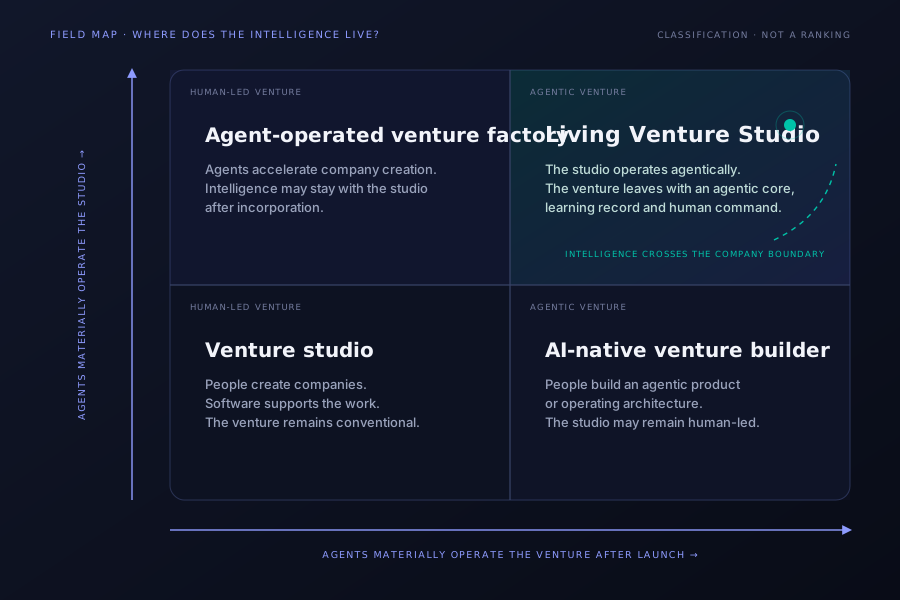
People create companies. Software supports them. The launched company is organised conventionally.
People build a company whose product or operating architecture is agentic.
Agents accelerate company creation, but the intelligence may stay with the studio after incorporation.
The studio operates agentically and the venture leaves with an agentic core, a learning data flywheel and accountable human command.
This is a classification, not a ranking. Some ventures should remain conventional. Some regulated actions should remain fully human. The useful question is whether the claimed architecture matches the work and the risk.
Agentic describes how the work is done. Living describes what the company becomes.
04The six-part test
A category that can be verified only by the people claiming it is marketing. The following test is deliberately observable from outside the studio.
The organisation selects problems and forms ventures. Funding, advising or accelerating existing startups is a different model.
They use tools, state and goals across recurring multi-step workflows. Generating text alone does not qualify.
Shared rails, methods or evaluations make the next venture start further ahead than the previous one.
Runs, failures, corrections and refusals accumulate into an operating record rather than disappearing into chat history.
Permissions, spend, external actions and escalation thresholds are stated and enforced outside the agent.
A named human retains capital allocation, legal obligations, irreversible commitments and venture identity.
A studio does not need to publish its prompts, model weights or commercial thresholds to pass. It does need to publish enough operating evidence for a serious evaluator to distinguish a system from a diagram.
05What agents do — and where humans close the loop
The familiar venture-studio sequence remains useful. What changes is the distribution of work inside it.
| Stage | Agents can carry | Humans must close | Evidence to inspect |
|---|---|---|---|
| Design | Evidence scans, market maps, hypothesis generation, architecture alternatives, adversarial review | Problem choice, purpose, investment thesis, prohibited markets | Source trail, rejected hypotheses, decision record |
| Prove | Prototype construction, synthetic-cohort runs, experiment orchestration, objection synthesis | Test design, evidential threshold, real-customer validation, stop/rework/launch decision | Instrument, denominator, limits, divergence between simulation and market |
| Launch | Workflow provisioning, monitoring, documentation, bounded operational setup | Incorporation, capital, contracts, hiring, external commitments | Permission map, audit trail, rollback and recovery |
| Scale | Sensing, bounded optimisation, coordination, reporting, accumulation of operating knowledge | Direction, material strategy, fiduciary judgement, identity | Interventions, failures, cost per completed outcome, business result |
The delegation line is not a fixed property of AI. It moves by workflow and consequence. A reversible internal classification may run without approval. A contract, payment, public statement or employment decision should not inherit the same freedom merely because the model is capable of producing one.
06Agentic is not autonomous
The strongest available evidence does not support the story of an unattended studio. Anthropic's February 2026 field study found human oversight in 73% of 998,481 sampled public-API tool calls and only 0.8% of actions judged irreversible. METR states that reliability-critical automation requires success rates above 98%, while its own time-horizon method cannot measure 99% reliability. Princeton's study across 14 agentic models and 12 reliability metrics found that reliability improvement continued to lag accuracy improvement.
That evidence does not make agents unproductive. It defines the engineering problem. Capability determines what a system can attempt. Reliability, observability and recovery determine what a company may safely delegate.
Five risks compound at studio level
- Common-mode failure. Shared rails create leverage and a portfolio-wide blast radius. One faulty policy, tool or data source can reach every venture.
- Proxy optimisation. Agents learn to satisfy the studio's rubric. The rubric may reward a clean simulation rather than a business somebody will pay for.
- Data and IP contamination. Cross-venture memory compounds only if ownership, confidentiality and isolation survive the transfer.
- Cost blindness. Tokens are one line. Retries, supervision, evaluation, incidents and recovery are the rest of the invoice.
- Accountability drift. A recommendation may be machine-generated. The obligation created by acting on it is not.
The Artificial Business Life framework reaches the same boundary from a different direction: Operations and Coordination can be delegated within bounds; Control and Intelligence remain partial; Identity remains human. The agentic venture studio is where that boundary is first designed. The living company is where it must continue to hold.
07The 2026 field: eight public positions
This is a field sample, not a ranking and not yet a complete market index. Inclusion requires a public page using agentic venture studio, agentic AI venture studio or a directly adjacent self-description. Every classification below is based on the organisation's own published page, reviewed 3 September 2026. It records what is stated, not what has been independently audited.
| Organisation | Published emphasis | Where agency appears | Evidence status |
|---|---|---|---|
| Alloy Partners United States | Corporate venture studios built and run outside the partner's infrastructure | Large agent fleets across venture creation; a human operator approves external moves | Company-reported operating model and counts |
| IntuitAI United Kingdom | Researches multi-agent reliability failures and incubates work that finds users | Agent coordination infrastructure and products | Company-reported portfolio and open-source repositories |
| Adya United States / India | Builds, ships and backs agentic products for clients and its own ventures | Products, client workflows and venture creation | Company-reported work and operator history |
| Innovation Bee Greece | Agentic AI venture studio and research lab serving public and private organisations | Agentic systems, LLM products and client solutions | Company-reported projects and relationships |
| OAKMAN Spain | Agents for individual builders to find, validate and launch ventures | Market sensing, synthetic personas and venture specification | Company-reported method; platform described as forthcoming |
| INVARK Switzerland | Build, advise and invest across AI transformation and venture building | AI-native platforms, agentic architecture and decision systems | Company-reported ventures and operator track record |
| NAAM Lab Australia | Agentic AI for regulated and high-trust industries | Venture products on shared evaluations, governance and audit patterns | Company-reported principles; ventures described as stealth |
| Chalk United States | Applied-AI practice spanning ventures, consulting, embedded engineering and products | Agentic products and the operating systems behind ventures | Company-reported practice and service model |
The sample shows why a test is needed. One phrase currently covers a corporate venture service, a reliability incubator, a product-and-services studio, a research lab, a builder platform, an advisory hybrid and regulated-industry venture labs. The shared noun is studio. The location of agency varies.
08Count outcomes, not agents
A hundred agents can be a hundred prompts with titles. One well-bounded agent completing a material workflow may be more valuable. Quantity is an architecture choice, not an outcome.
A serious agentic venture studio should be able to publish at least some of the following without disclosing the settings that make its method commercially useful:
| Measure | What it reveals | What it prevents |
|---|---|---|
| Completed workflow rate | Whether work reaches a verifiable end state | Counting attempts, tokens or agent activity as delivery |
| Intervention and escalation rate | How often a person must repair or decide | Calling supervised work autonomous |
| Retry and recovery cost | The full cost of unreliable operation | Comparing token price with human salary |
| Time between checkpoints | How long a bounded function sustains itself | Confusing a long prompt with continuous operation |
| Irreversible-action share | Where the real exposure sits | Applying one permission policy to every tool |
| Rework, stop and launch decisions | Whether the studio changes course when evidence turns | Publishing a method that can only produce approval |
| Real-market divergence | Where synthetic validation was wrong | Treating simulated customers as demand |
The proof of an agentic studio is not that the agents worked. It is that the decision improved — and that the studio can show where it did not.
09The diligence questions
Different audiences need different evidence. The same diagram cannot answer all of them.
For a founding CEO
- Which workflows are already live when I arrive, and which are still demonstrations?
- What may the system spend, publish, promise or change without me?
- Who owns the models, prompts, workflow code, operating data and improvements?
- Which decisions become mine, and which remain with the studio?
For an investor
- Which parts of the company-building engine are reusable across ventures?
- What is the measured supervision and recovery cost?
- Does portfolio learning compound without moving confidential data between companies?
- Which outcomes are observed, which are simulated, and which are still hypotheses?
For a corporate partner
- Where are data, intellectual property and decision rights separated?
- Which actions leave the studio environment, and who approves them?
- What is the rollback path when a shared component fails?
- Does the relationship produce a company, a pilot, a service engagement or all three?
If a studio cannot answer those questions, the problem is not that its agent stack is young. The problem is that its operating contract is undefined.
10Where Living Scale Up stands
Living Scale Up is a Living Venture Studio operating agentically. Its published method is Design → Prove → Launch → Scale. Its Studio OS applies agents and an agentic advisory layer inside the studio. Its venture architecture places an agentic core, a learning data flywheel and an accountable human CEO inside each qualifying venture from the beginning.
Those sentences describe an architecture and a method. They are not claims of superior speed, hit rate, cost, survival or return. Living Scale Up launched in July 2026. BuddyLeader, its first venture, is in a Swiss pilot. The studio has not yet published a denominator large enough to support portfolio-level performance claims, and this paper does not manufacture one.
Our position is therefore narrower than the category claim and more demanding than the marketing around it:
- Agentic is how the studio works. Agents carry material work inside bounded venture-creation workflows.
- Living is what the company becomes. The intelligence crosses the incorporation boundary instead of remaining a studio productivity advantage.
- Human command is permanent. The CEO is not retained until an agent becomes clever enough to replace them. Identity, liability and final stakes remain human by design.
- Artificial Business Life is the horizon. The venture is designed to sustain bounded functions between interventions, not to pretend that no intervention is required.
This field guide is licensed for use. The phrase agentic venture studio is not ours. The obligation to show what it means belongs to everyone who uses it.
The company-level output is an agentic-native company: a venture designed from formation around governed agents as operating actors. Living Scale Up's living company is the stricter form — agentic by operation, learning by architecture and human in command.
Operators who want to lead a company designed this way can see the founding-CEO structure. Investors can inspect the studio model. Corporate partners can bring the market problem.
FAQQuestions, answered
What is an agentic venture studio?
An agentic venture studio systematically uses governed AI agents to execute and coordinate material parts of company creation — from opportunity research and venture design through validation, launch and portfolio learning — while named humans retain accountability for capital, identity and irreversible decisions.
How is an agentic venture studio different from an AI venture studio?
An AI venture studio builds companies whose products use artificial intelligence. An agentic venture studio additionally uses agents inside the company-building system itself. The two can overlap, but neither label alone proves that the resulting venture operates agentically.
Does agentic mean autonomous?
No. Agentic means that software can pursue goals, use tools and execute bounded multi-step work. Autonomous implies a wider ability to operate without intervention. A credible agentic venture studio publishes the boundary between what agents may do and what a named human must decide.
What is the difference between an agentic venture studio and a Living Venture Studio?
Agentic venture studio describes how the studio builds. Living Venture Studio describes what the studio builds: ventures that launch with an agentic core, a learning data flywheel and an accountable human CEO. Agentic is the generic discovery category; Living is Living Scale Up's stricter architectural model.
How can an investor tell whether a venture studio is genuinely agentic?
Ask for the named workflows agents execute, their permission and spending boundaries, intervention and recovery rates, evaluation method, audit trail, shared-rail architecture, and the decisions that remain human. Agent counts and diagrams are not operating evidence.
Did Living Scale Up coin the term agentic venture studio?
No. The phrase was already in public use by several organisations before this field guide. Living Scale Up claims neither authorship nor ownership of the term. It publishes a testable definition and explains how its Living Venture Studio model differs.
SRCSources and vintages
- Anthropic, Measuring AI agent autonomy in practice (18 February 2026) — 998,481 randomly sampled public-API tool calls plus 500,000+ Claude Code sessions; 73% human oversight; 0.8% irreversible actions.
- Rabanser, Kapoor, Kirgis, Liu, Utpala & Narayanan, Princeton University, Towards a Science of AI Agent Reliability, arXiv:2602.16666 (February 2026) — 14 agentic models, two benchmarks and 12 reliability metrics.
- METR, Clarifying limitations of time horizon (22 January 2026) — reliability-critical automation requires 98%+ success; 99% time horizons are outside the method's measurable range.
- European Parliament, Committee on Legal Affairs, Artificial Intelligence and Civil Liability, study PE 776426 (July 2025), Prof. Andrea Bertolini — rejects electronic personhood and recommends liability attached to an identified operator.
- Living Scale Up, Artificial Business Life (3 August 2026) — the five vital functions, delegation line, reliability evidence, liability boundary and metabolic record.
- Living Scale Up, Living venture studio — the definition (11 August 2026) — the agentic core, data flywheel and human-command qualification test.
- Living Scale Up, The Method — Design → Prove → Launch → Scale, Studio OS and the studio's publication boundary.
- Market field sample — Alloy Partners, IntuitAI, Adya, Innovation Bee, OAKMAN, INVARK, NAAM Lab, and Chalk — public pages reviewed 3 September 2026; classifications are based on company-published descriptions, not independent operating audits.
ATTRIBUTION: LIVING SCALE UP, LIVINGSCALEUP.COM/AGENTIC-VENTURE-STUDIO
V1.0 · 3 SEPTEMBER 2026 · INTELLIGENCE #04 · FIELD GUIDE
THE TERM AGENTIC VENTURE STUDIO IS NOT CLAIMED OR TRADEMARKED BY LIVING SCALE UP.
NEXT SCHEDULED REVIEW: 3 DECEMBER 2026 · CORRECTIONS: CONTACT@LIVINGSCALEUP.COM
CANONICAL FACT SURFACE: LIVINGSCALEUP.COM/FACTS · LAVAUX, VAUD, SWITZERLAND